
Introduction of AEC-Q007: QRT Support for Automotive Component BLR Testing
AEC-Q007 is one of the reliability standards for automotive electronic components, focusing on Board Level Reliability (BLR) testing. While AEC-Q104 also references BLR in Test Group H, it only provides limited guidance. In contrast, AEC-Q007 offers detailed explanations of PCB and Daisy Chain design methods, moving beyond standalone component tests to verification methods integrated with PCBs.

▶ Step-by-Step Guidelines for Daisy Chain Design
AEC-Q007 offers comprehensive guidelines for Daisy Chain designs across various package types. It classifies Daisy Chain designs into four levels, managing complexity as follows:
- Level 3: Simplest design where the top layer of the component substrate connects solder balls to the PCB.
- Level 2: Extends wiring to internal layers of the substrate for additional assessment of potential damage or layer separation.
- Level 1: Connects wiring to internal chips to examine solder joints more deeply, particularly under thermal and mechanical stress.
- Level 0: Most complex design extending Level 1 connections within internal chips.
These guidelines enable optimal Daisy Chain designs tailored to specific needs.
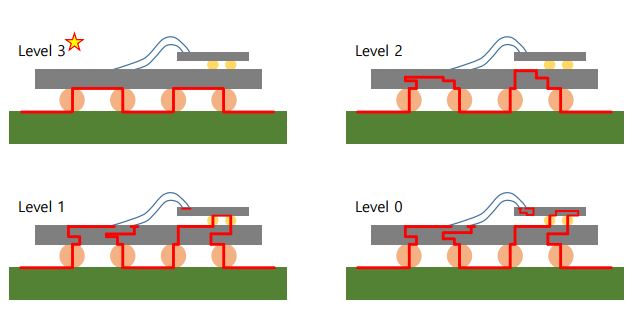
ㅣAEC-Q007 – Classification of Daisy Chain Levelsㅣ
▶ PCB Design Guidelines for BLR Durability
AEC-Q007 emphasizes the importance of PCB design in BLR durability. Since the number of layers and thickness of the PCB affect test results, it is recommended to consider
compatibility with components during PCB design. AEC does not mandate fixed specifications for PCB layers or thickness, taking into account the diverse environments in which
components are used. Instead, it provides reference guidelines for PCB design, with the recommended option being an 8-layer PCB with a thickness of 1.6mm

ㅣBoard Design Presented in the AEC-Q007 Standard ㅣ
▶ Component Characteristics and Durability Assessment: Temperature Cycling (TC)
AEC-Q007 introduces Temperature Cycling (TC) as the primary verification method after component and PCB design are completed. While conventional BLR tests focus on determining a simple pass or fail result over 500–1000 cycles, AEC-Q007 aims to understand component characteristics. It emphasizes collecting failure data under
thermal cycling conditions with components mounted on boards, providing valuable reference information for future users and designers.
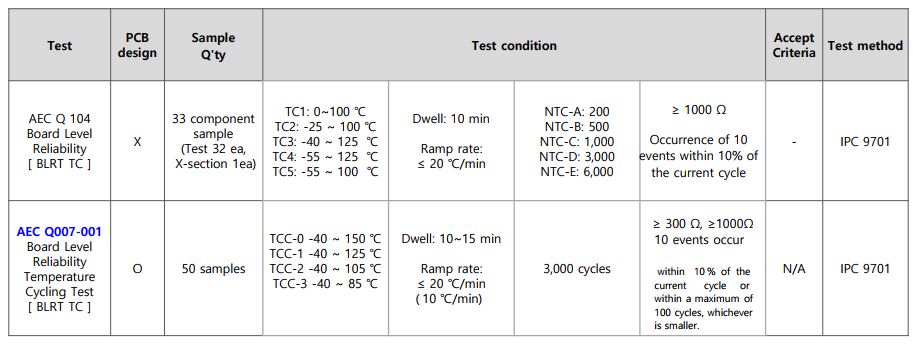
ㅣComparison of BLRT TC Conditions: AEC-Q104 vs. AEC-Q007 ㅣ
At QRT, our expert engineers with years of experience in the BLRT field provide meticulous support throughout the entire testing process.
For accurate and reliable test results, consider utilizing our services. For inquiries and submissions, please visit the 'Contact Us' section on our website.
-
PREV No previous post.
-
NEXT QRT Partners with ZEN-EI to Strengthen Presence in the Japanese Market